Turnitin Similarity Score: What’s Acceptable?
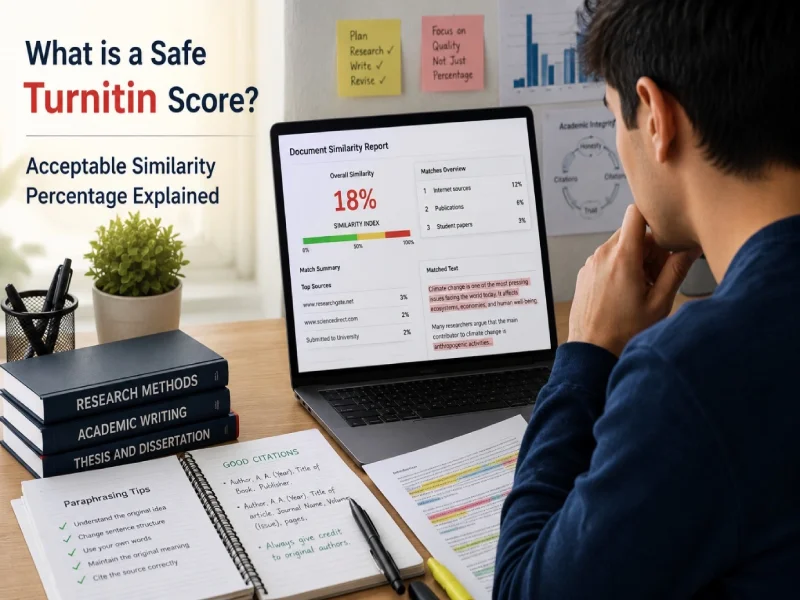
Your Turnitin report comes back, and there’s a number sitting next to it in blue, green, or orange. For a lot of students, that single percentage feels like the whole verdict—pass or fail, safe or caught. But a similarity score isn’t a grade, and it isn’t a judgment on its own. It’s just a percentage of text that matches something already in Turnitin’s database, and that match could mean almost anything.
This is exactly where most of the confusion starts. A properly cited quote, a required title page, or a common phrase in your field can all raise that number the same way uncited copying would. So instead of asking “Is my score good or bad?” the more useful question is what your similarity score is actually made of and what’s genuinely worth fixing before you submit. That’s what this guide walks through.
What Your Similarity Score Is Measuring
Turnitin doesn’t check whether your work is original in the way a professor reads for originality. It checks whether your wording matches text that already exists somewhere in its database: student papers, journals, websites, and previously submitted assignments. When it finds an overlap, that section gets highlighted, and the percentage adds up every highlighted piece into one number.
That’s why the Turnitin similarity score can’t tell the full story by itself. A properly quoted line, a reference list, or even a required assignment prompt can match existing text without any dishonesty involved. The percentage only tells you how much text overlaps, not why it overlaps. Understanding that difference is the first step before you look at the number and decide anything about it.
What’s Acceptable, In Simple Terms
Most institutions treat a score under 15 to 20 percent as low-risk, since that range usually reflects quotes, references, and common phrasing rather than uncited copying. Scores in the low to mid-30s can still be fine if the overlap comes from properly cited sources, especially in research-heavy assignments. Once a similarity score climbs consistently higher than that, or the matches aren’t backed by citations, it’s worth a closer look before you submit.
These numbers are patterns, not fixed rules. Your actual answer always comes from your school’s own policy, which is exactly why the next section matters just as much as this one.
There’s No Fixed “Safe” Score
Students often go looking for one universal number that guarantees safety, but that number doesn’t exist. Turnitin itself is clear about this: acceptable similarity depends on your school, your instructor, and the type of assignment you’re submitting.
Why the Same Score Means Different Things
A literature review with heavy citation will naturally sit higher than a short reflection paper, and a professor may treat those two numbers very differently even if they look similar on paper. Context decides the meaning, not the percentage alone.
Check Your Own Institution’s Standard
Checking your syllabus or asking your instructor directly matters more than chasing a specific percentage. Some departments are comfortable with scores in the 20s if citations are solid, while others expect single digits.
Focus On What Actually Counts
Once you know what your institution considers acceptable, put your effort where it matters: reviewing matched text, tightening citations, and learning to avoid plagiarism in university assignments instead of guessing at a number that was never fixed in the first place.
Read the Color, Then Read the Report
The colored icon next to your score gives you a quick visual cue, but it isn’t the full picture. Blue or green usually means low overlap, and green through yellow still falls in a range most instructors won’t question. Orange and red are where a closer look becomes necessary because the matched text is heavier and needs context to explain.
Colors are a starting point, not a conclusion. The real answer sits inside the report itself, where you can see exactly which sources matched and how much of your paper each one covers.
| Color Range | What It Usually Signals | What To Check Next |
| Blue / Green (0–24%) | Low overlap, often just quotes or common phrasing | Confirm citations are still accurate |
| Yellow (25–49%) | Moderate overlap, worth a scan | Look for uncited paraphrasing |
| Orange (50–74%) | Heavy overlap, needs review | Identify which sources are repeating |
| Red (75–100%) | Very high match, requires action | Rewrite flagged sections before submitting |
What’s Driving Your Score
Before you touch a single sentence, find out what’s actually causing the match. Open each highlighted section and sort it into one of four categories: direct quotes, your bibliography, a required template or assignment prompt, or text you genuinely wrote too close to a source. Each of these needs a different response, so lumping them together only wastes time.
A student writing a research-heavy paper with several long, properly cited quotes can land at 35% or higher purely from that quoted material. That score looks alarming next to a lower one, but it reflects strong sourcing, not weak writing. The only sections worth revising are the ones where your own wording overlaps with a source and no citation backs it up.
How to Lower Your Similarity Score
Once you’ve isolated the sections that genuinely need work, paraphrasing is your main tool but it has to go beyond swapping a few words. Read the original source, close it, and write the idea in your own sentence structure using your own reasoning. Then cite it properly even if the wording is entirely yours, since the idea still belongs to someone else. This single habit resolves most uncited overlap without touching anything that was already correctly sourced.
Balancing research depth with original wording is a skill that takes practice, which is exactly why assignment writers with 15+ years exp. tend to cite heavily while still keeping their similarity scores low. They know which sentences need direct citation and which ones can be reframed entirely in their own words. Building that same instinct for yourself, one paragraph at a time, matters more than any single revision pass before submission.
Don’t Let Deadlines Set Your Score
A tight deadline is one of the most common reasons a similarity score climbs higher than it should. When time runs short, students lean harder on existing sources, copy structure from templates, or paste in text they meant to rewrite later and never get back to. Research on academic integrity backs this up consistently: time pressure, not dishonesty, is one of the biggest drivers behind uncited overlap.
Why Rushed Work Raises Your Score
When you’re working against the clock, paraphrasing gets skipped and citations get added last, if at all. That’s exactly the kind of gap Turnitin catches.
It’s A Timing Problem, Not A Character One
Recognizing this pattern matters because the fix isn’t about trying harder under pressure. It’s about learning to handle academic deadlines earlier, so your writing process has room for the paraphrasing and citation checks that keep your score where it should be.
Plan Ahead For A Cleaner Score
A few small habits built into your process can keep your similarity score in check even when time is tight. None of these require extra hours, just a different order of operations.
Use Draft Checks
If your department allows early or draft submissions, use that window. Reviewing a preliminary report gives you time to fix flagged sections before the final deadline instead of discovering them too late.
Block Your Time
Splitting your writing into smaller sessions, research, drafting, then citation review—keeps paraphrasing from becoming an afterthought. Each stage gets proper attention instead of being rushed together the night before.
Start Citations Early
Adding citations as you write, rather than after the draft is done, prevents the last-minute gaps that usually drive similarity scores up. This is really what it takes to complete last-minute assignments without stress. The goal isn’t working faster. It’s building a process that doesn’t leave your similarity score to chance.
Know When It’s Time To Ask For Help
Sometimes the workload itself is the real issue, not your writing process. If assignments keep piling up faster than you can manage them honestly, that’s a signal to get support instead of cutting corners on originality.
Use Campus Resources
Writing centers, tutoring services, and your instructor’s office hours exist for exactly this situation. Many students don’t realize these resources can help with structuring an argument, understanding citation formats, or simply reviewing a draft before submission.
Recognize Genuine Overload
There’s a difference between typical deadline stress and a workload that’s genuinely unmanageable. Students juggling multiple courses, jobs, or personal circumstances often start searching how can i get someone to write my assignment simply because they’re out of time, not out of effort.
Ask Before It Becomes a Crisis
Reaching out early, whether to a professor, a tutor, or someone you trust to do my assignment review with you, is far more effective than trying to fix everything the night before it’s due. Asking for help isn’t a shortcut. It’s part of managing coursework realistically.
Frequently Asked Question
What is a good Turnitin Similarity score?
Most sources agree there’s no single “good” number, but scores under 15–20% are commonly treated as low-risk across institutions, provided the matches come from proper citations rather than uncited copying.
Is 30% similarity on Turnitin bad?
Not automatically. A 30% score usually needs a closer look, but it depends on the source of the match. Heavy quoting or a long bibliography can push the number up without any dishonesty involved.
Does a single large match matter more than several small ones?
Yes. A Turnitin similarity score made up of many small matches spread across different sources is usually far less concerning than the same percentage coming from one large, uncited block of text.
Can Turnitin be wrong?
Its similarity checker can misread common phrases, shared templates, or standard citations as matches, and its separate AI detector carries a known false-positive rate, so any flagged similarity score is worth reviewing in context, not taken at face value.
Should I ask my instructor what score is acceptable?
Yes. Since acceptable ranges vary by school, course, and assignment type, checking directly with your instructor is more reliable than relying on a general benchmark.
Conclusion
Your similarity score is a starting point, not the final word on your work. The number only tells you how much text overlaps with existing sources, not why. That answer sits inside the report itself, in the sections Turnitin actually highlights.
Before you worry about a percentage, open the report and read what’s flagged. Confirm your citations are accurate, revise anything that’s genuinely too close to a source, and let the rest stand. That habit matters far more than any single number ever will.

As the author of the blog at SingaporeAssignmentHelp.com.sg, I provide practical guidance on academic writing challenges, breaking down complex project requirements into simple, easy‑to‑follow steps. My posts cover essays, assignments, business plans and research writing, helping learners understand what professors expect and how to meet those standards effectively. I aim to help students in completing work confidently, improving grades and reducing academic stress while navigating university and college requirements with clarity and success.